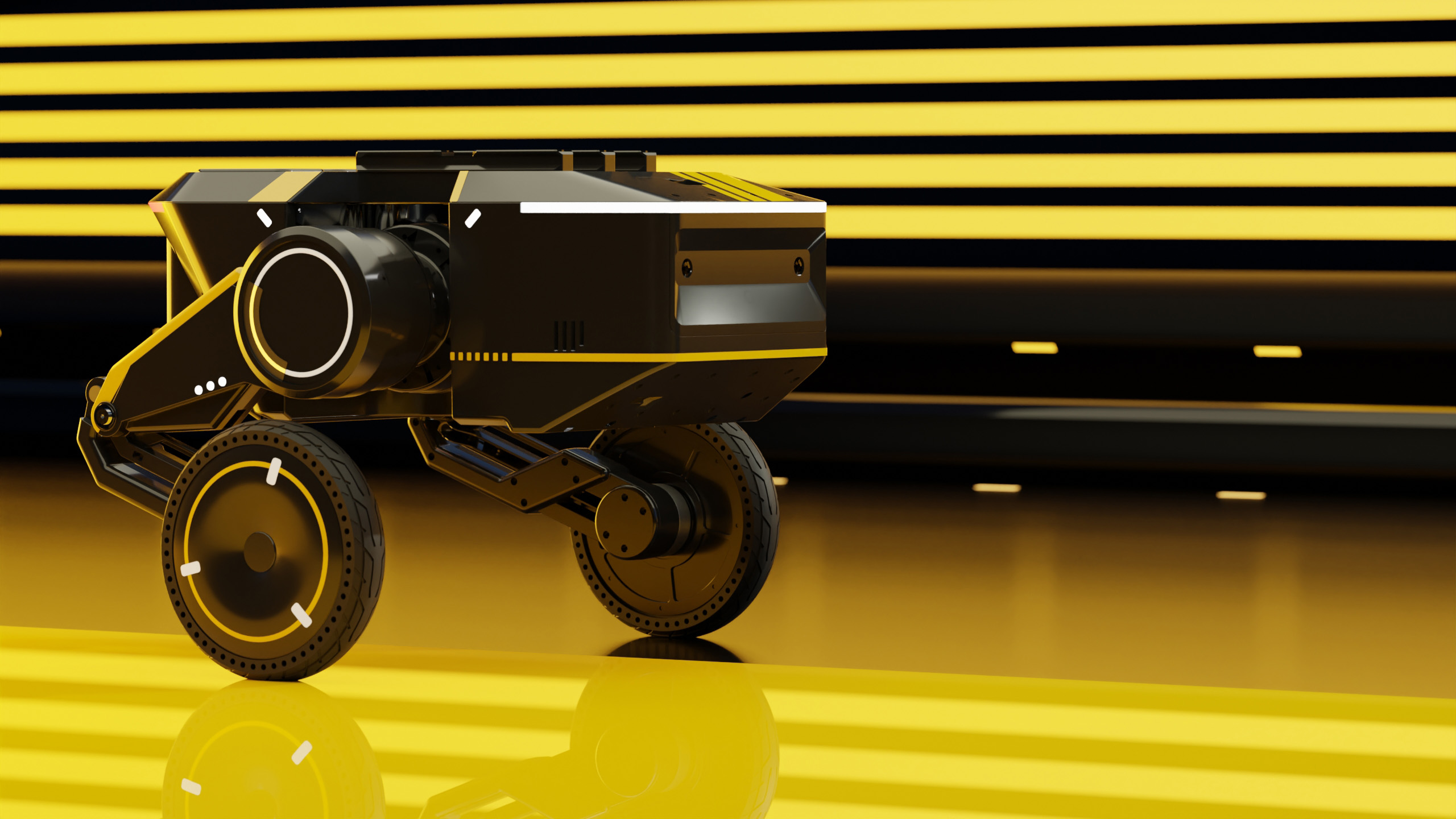
An 8-DoF wheeled bipedal robot combines wheel-based speed with leg-based terrain adaptation through eight independently controlled joints, allowing stable movement across slopes, steps, gravel, and uneven surfaces. Modern platforms use LiDAR, IMU, torque sensing, and real-time control loops operating at 100–1000 Hz to adjust posture, traction, and wheel contact. Research prototypes have demonstrated climbing slopes above 20°, crossing obstacles of 10–30 cm height, and maintaining balance under external disturbances, making them suitable for inspection, exploration, and autonomous mobility.
Robotic mobility has traditionally been divided into two categories: wheeled robots optimized for speed and legged robots designed for terrain adaptability. Wheeled systems can achieve speeds 2–5 times higher than walking robots on flat ground, but their performance decreases rapidly when facing steps, loose surfaces, or irregular terrain. Legged robots solve many of these problems but usually consume more energy because continuous balance control requires frequent actuator adjustments. The 8-DoF wheeled bipedal robot combines both approaches by using wheels for efficient transportation and articulated legs for posture adjustment.
In 2023, several research groups reported wheeled-legged platforms capable of switching between high-speed rolling and adaptive stepping modes, reducing energy consumption by approximately 30% compared with fully legged locomotion during long-distance movement.
An eight-degree-of-freedom structure gives the robot enough mechanical flexibility to regulate body height, wheel alignment, and ground contact forces. A typical design includes two powered wheels, four leg joints, and additional steering or ankle adjustment mechanisms. Each actuator contributes to maintaining balance and controlling movement across different terrain conditions.
| Component | Function | Typical specification |
|---|---|---|
| Wheel motors | Provide forward movement | 100–500 W class actuators |
| Leg joints | Adjust height and posture | Torque-controlled servo systems |
| IMU sensors | Measure orientation | 100–1000 Hz sampling |
| Depth cameras/LiDAR | Build terrain maps | centimeter-level perception |
The mechanical design allows the robot to lower its body when climbing, extend its legs when crossing gaps, and adjust wheel angles when encountering uneven ground. The eight controlled degrees of freedom provide continuous posture regulation instead of fixed wheel-ground contact.
Terrain understanding determines how the robot selects its movement pattern. Modern wheeled bipedal robots combine cameras, LiDAR, inertial sensors, and force feedback systems to estimate surface geometry before movement. A perception module can identify slope angles, obstacle heights, and available pathways within milliseconds.
For example, when approaching a 15° incline, the robot may shift its center of mass forward, increase wheel torque, and modify leg stiffness to maintain traction. When detecting loose gravel, the controller can reduce acceleration and increase vertical force distribution to prevent wheel slipping.
A 2022 outdoor mobility test using a wheeled-legged robot evaluated more than 50 terrain conditions, including concrete, grass, gravel, and inclined surfaces, showing that adaptive posture control improved successful traversal rates by over 20% compared with fixed-wheel control.
The sensing process creates a continuous feedback cycle:
-
Terrain scanning through LiDAR and cameras
-
Surface classification through onboard algorithms
-
Motion planning according to terrain conditions
-
Joint and wheel adjustment during movement
This approach allows the robot to respond to terrain changes rather than relying only on pre-programmed routes.
The mechanical advantage becomes more visible on uneven surfaces where traditional wheels lose effectiveness. Stairs, rocks, and gaps create sudden height differences that require rapid body adjustment. The legs of a wheeled bipedal robot act as an active suspension system, absorbing terrain changes while maintaining the wheel contact needed for movement.
During obstacle crossing, the robot can extend one leg while keeping the opposite wheel stable. This asymmetric control method reduces body rotation and improves stability. Laboratory tests in 2021 showed that similar hybrid robots could cross obstacles approximately 1.5 times higher than their wheel radius while maintaining forward motion.
A wheeled bipedal robot does not replace wheels with legs; it uses leg movement to improve how wheels interact with the environment.
Wheel traction management is another important aspect of complex terrain operation. Wheel slip occurs when the rotation speed exceeds the actual movement speed, especially on sand, wet ground, or loose stones. Sensors compare wheel velocity with body acceleration to estimate slip conditions.
| Terrain type | Main challenge | Typical adjustment |
|---|---|---|
| Gravel | Reduced friction | Lower torque output |
| Slopes | Gravity influence | Forward body adjustment |
| Steps | Height difference | Leg extension |
| Wet surfaces | Wheel slipping | Speed reduction |
Control algorithms process these measurements and adjust torque, posture, and velocity. Modern systems often combine model predictive control (MPC), whole-body control, and reinforcement learning. MPC predicts future states within several seconds, while learning-based methods improve performance through simulation training.
A 2024 study on hybrid mobile robots reported that reinforcement learning policies trained with more than 1 million simulated movement cycles improved recovery ability after disturbances compared with manually designed controllers. These methods allow robots to handle terrain variations without requiring individual programming for every environment.
The robot’s application range has expanded from laboratories into practical environments. Industrial facilities require mobile platforms capable of inspecting pipelines, warehouses, and outdoor equipment. A wheeled bipedal robot can travel quickly through flat areas and adjust its configuration when encountering ramps or damaged surfaces.
In search and rescue scenarios, mobility requirements are even more demanding. After earthquakes or structural failures, terrain often contains debris, uneven blocks, and unstable surfaces. Hybrid locomotion allows robots to move through areas where conventional wheeled vehicles may become stuck.
Field tests between 2020 and 2024 showed that hybrid wheel-leg robots could complete navigation tasks across mixed indoor and outdoor environments with success rates above 80%, depending on terrain complexity and sensor configuration.
Commercial robotic platforms continue improving actuator efficiency and control accuracy. One example of compact direct-drive robotic technology can be found in systems using high-torque motors and integrated motion control units, such as direct-drive robotic actuator systems.
Future development focuses on improving autonomy, reducing energy consumption, and increasing reliability. Battery technology, lightweight materials, and advanced perception systems will determine how long these robots can operate outside controlled environments. Current prototypes typically operate between 1 and 5 hours depending on payload, terrain, and movement speed.
Artificial intelligence will also influence future locomotion planning. Instead of manually defining movement strategies, robots will increasingly learn terrain responses from large-scale simulation and real-world data. By combining visual information, mechanical feedback, and environmental models, future systems may achieve more flexible movement similar to biological locomotion.
The development of 8-DoF wheeled bipedal robots represents a shift toward mobile systems that can adapt their structure according to environmental conditions. With precise sensing, multi-joint coordination, and efficient wheel-based transportation, these robots provide a practical solution for complex terrain applications including inspection, exploration, logistics, and autonomous service tasks.